Berberine HCl vs Berberine Phospholipid: Which Form Actually Absorbs Better?
VitaLifeWorld UK · Updated 31 October 2026 · 7 min read · Cross-checked against ConsumerLab testing and Boots Health Hub guidance
HCl — most studied formThe bulk of published trials use it
Phospholipid — better absorption in some studiesEvidence is promising but thinner
£28–£45 vs £50+ per monthTypical UK monthly cost by form
Neither is a medicine in the UKBoth are sold as food supplements
🇬🇧 GBP pricing · UK delivery · Food supplement, not a medicine
The short answer
The one-paragraph version before the detail.
Both forms contain the same compound — berberine. The difference is the delivery system around it. Berberine HCl is the cheapest and by far the most studied; almost all the clinical evidence you read about uses it. Berberine phospholipid binds the compound to a fat molecule, and some research suggests that improves absorption and reduces stomach upset. The catch: it costs roughly twice as much, and there are far fewer head-to-head trials. If you are starting out, HCl at a stated dose is the sensible default. If you have a sensitive stomach or a higher budget, phospholipid is a reasonable upgrade — not a necessity.
Search any berberine product page and you will usually see one of two words after the compound name: HCl or phospholipid. The marketing makes it sound like a choice between a basic version and an advanced one. The reality is less dramatic and more useful: it is a trade-off between evidence, cost and stomach tolerance.
Want the most-studied form at a stated dose?
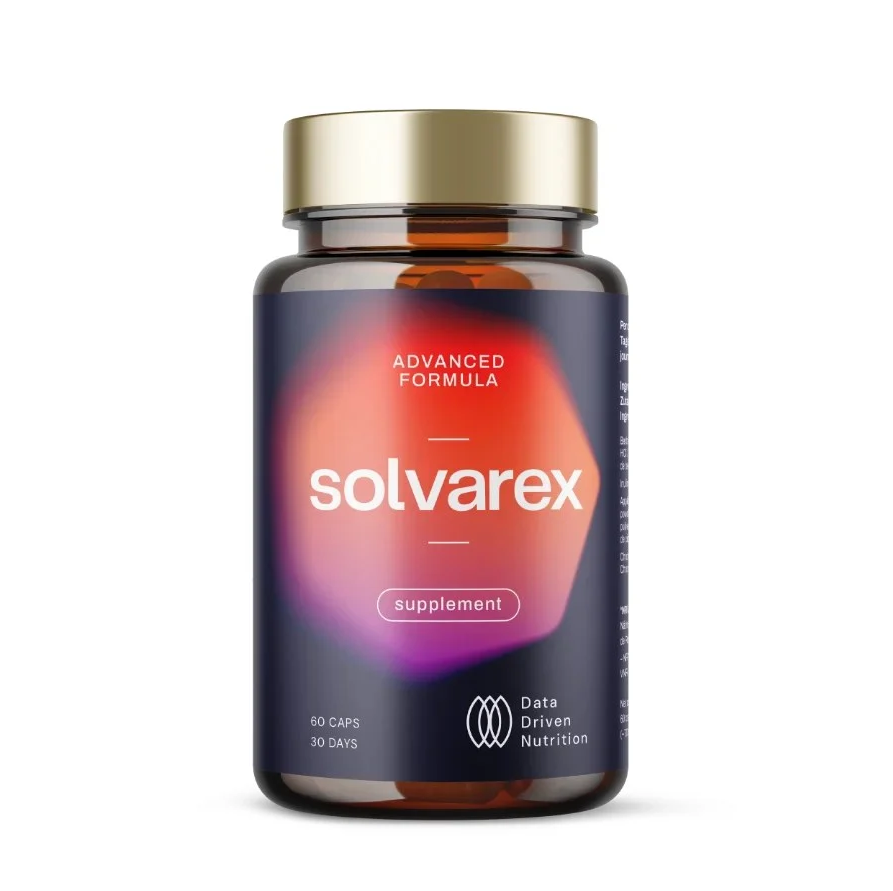
Solvarex uses berberine HCl — 250 mg per two-capsule serving, fully declared, alongside inulin, apple cider vinegar and chromium. From £36.65 per jar with UK delivery.
Food supplement, not a medicine · 30-day returns on unopened jars
What berberine HCl is
The form behind most of the published research.
Berberine hydrochloride is berberine bound to hydrochloric acid, which makes the compound water-soluble and stable enough to put in a capsule. It is the form used in the overwhelming majority of published research and the form found in most UK products.
Why it dominates the literature: HCl is cheap to produce, stable on the shelf and easy to standardise. That is exactly why researchers used it — and why most of what we know about berberine is knowledge about berberine HCl specifically.
Well characterised
Low cost per gram
Standard oral absorption
GI upset reported at higher doses
What berberine phospholipid is
A delivery system, not a different molecule.
Berberine phospholipid — sometimes sold as berberine phytosome — wraps the berberine molecule in a phospholipid (a fat-like carrier). The idea is that the fat-soluble shell crosses cell membranes more readily than plain berberine, which is poorly absorbed on its own.
The honest caveat: the absorption advantage comes from a small number of studies, often funded by the manufacturers of the branded delivery systems themselves. It is plausible and it is promising — but it is not the same weight of evidence as the HCl literature.
Emerging evidence
Fewer head-to-head trials
Reported fewer GI effects
Typically £50+ per month
Head-to-head comparison
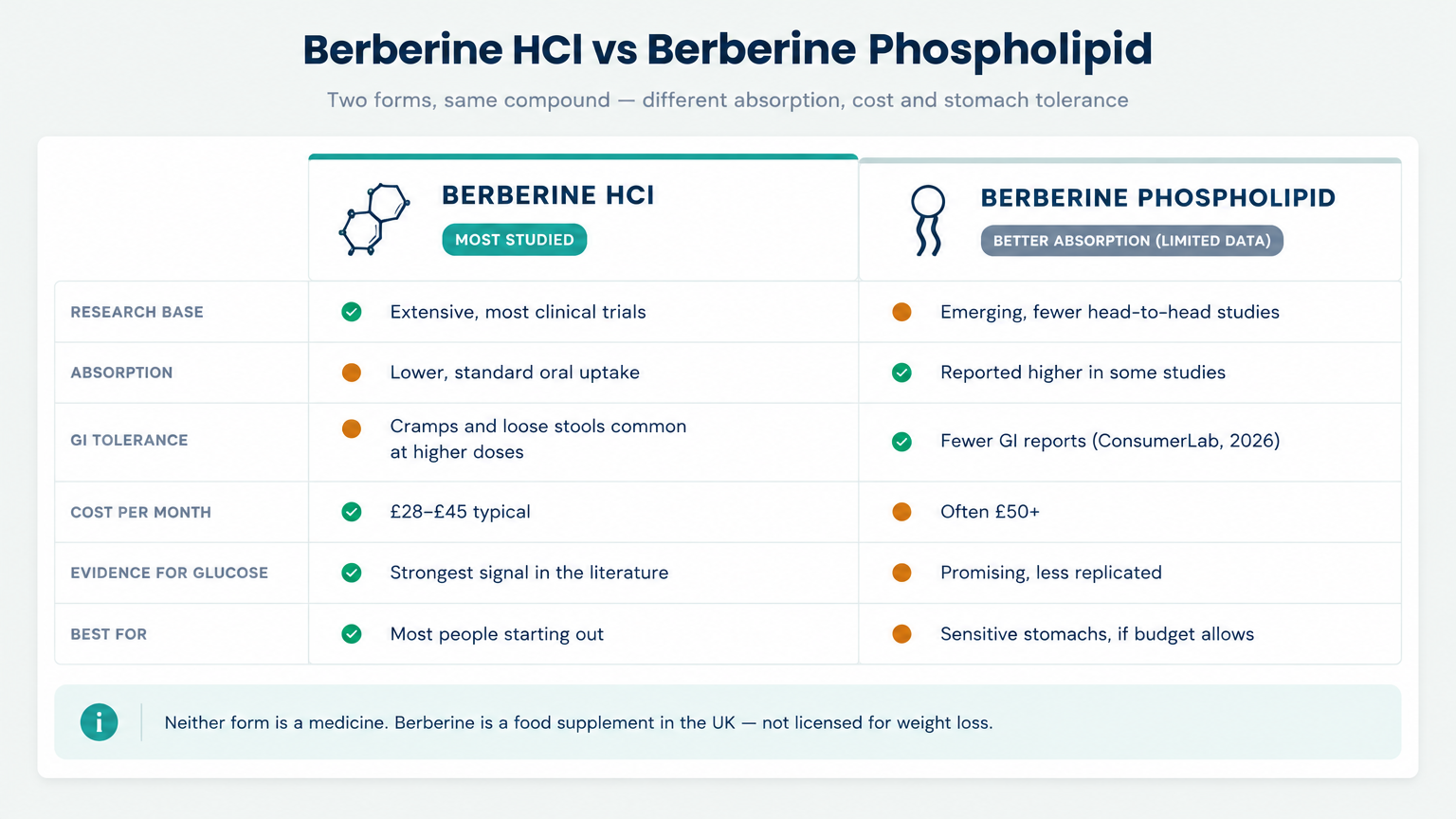
The core of the page: the same comparison in graphic and text form.
Here is the same comparison in text form, so you can check the numbers rather than rely on the graphic.
Form
Research base
Absorption
GI tolerance
Typical monthly cost
Berberine HCl
Extensive — most clinical trials
Standard oral uptake
Cramps and loose stools reported at higher doses
£28–£45
Berberine phospholipid
Emerging — fewer head-to-head studies
Reported higher in some studies
Fewer GI reports (ConsumerLab, 2026)
Often £50+
Berberine phytosome
Branded delivery form
Claimed improved bioavailability
Limited independent comparison data
Varies
Read the table carefully: the phospholipid column wins on absorption and tolerance, and loses on evidence volume and cost. Neither column wins everything. Anyone telling you one form is simply better is selling that form.
The absorption claim, examined
Why the argument is worth taking seriously, and where it stops.
The absorption argument is the strongest card the phospholipid sellers hold, and it is worth taking seriously — berberine on its own is genuinely poorly absorbed, which is why research doses are so high.
Berberine has low oral bioavailability. This is well documented and is the main reason doses in research run to 1,000 mg and above.
A phospholipid carrier can improve uptake. Studies on phytosome forms report higher plasma levels than plain berberine in the same dose.
But better absorption does not automatically mean a better outcome. No trial has shown that the phospholipid form produces meaningfully greater clinical results than HCl at an equivalent dose.
What this means practically: if you absorb more of a compound, you may be able to take less of it — which partly offsets the higher price. But nobody has demonstrated that this translates into a better result, and the price gap is wide.
Cost per gram of berberine
The comparison almost nobody publishes.
Price per bottle tells you nothing. The only fair comparison is what you pay per gram of actual berberine.
1Find the berberine per servingFor example: 250 mg per two-capsule serving.
2Multiply by servings per pack250 mg × 30 servings = 7,500 mg, or 7.5 g per jar.
3Divide the total price by the grams£36.65 ÷ 7.5 g = about £4.89 per gram of berberine.
Try this on any two products before you buy. A cheaper bottle with a hidden dose can work out more expensive per gram than a pricier one that states exactly what is inside. This is the single most useful calculation in the berberine market — and almost nobody publishes it.
£36.65 per jar on the three-jar routine
About £1.22 per day · delivery included · 30-day returns on unopened jars
You want the form with the most clinical evidence behind it
Cost per month matters to you
You have no history of digestive sensitivity
You prefer a product whose dose is stated clearly
Consider berberine phospholipid if…
You tried HCl and had stomach cramps or loose stools
Your budget allows roughly £50+ per month
You accept that the absorption evidence is promising but thinner
You are already experienced with berberine and want to optimise
Solvarex uses berberine HCl — stated, not hidden
Our own pick for the most-studied form, with the dose on the label.
Solvarex is built on the four-ingredient formula covered in our main guide. The berberine in it is HCl, at 250 mg per two-capsule serving, alongside inulin 360 mg, apple cider vinegar powder 160 mg and chromium picolinate 200 µg (714% NRV). No proprietary blend.
Where it sits: 250 mg is below the 500–1,500 mg range used in most published research, and it is the HCl form. That makes it a modest daily supplement, not a clinical dose. We say the same thing on our Solvarex page.
£54.95 one jar£41.95/jar for two£36.65/jar for three
Short, direct answers to the questions that come up most.
Is berberine phospholipid better than berberine HCl?
Phospholipid forms show better absorption in some studies, but the evidence base is smaller and the product costs roughly twice as much. Neither form is proven to produce better clinical results.
Why is berberine phospholipid more expensive?
The price reflects the cost of the proprietary phospholipid delivery system used to bind berberine, on top of the berberine itself.
Can I switch from HCl to phospholipid?
Yes, you can switch, but allow a few weeks to judge how your stomach and routine respond before drawing conclusions.
Which form does most research use?
Berberine hydrochloride (HCl) is used in the large majority of published clinical research and is the form found in most UK products.
Is berberine phytosome the same as berberine phospholipid?
Phytosome is a registered trade name for a phospholipid-based delivery system, so it is a type of phospholipid form rather than a separate chemical.
Does better absorption mean better results?
Not necessarily. No direct comparative trial has shown that the phospholipid form gives meaningfully greater clinical results than HCl at an equivalent dose.
Which form is gentler on the stomach?
Some consumer testing reports fewer gastrointestinal effects with the phospholipid form (ConsumerLab, 2026), but individual tolerance varies.
Is either form a medicine in the UK?
No. Both forms are sold as food supplements in the UK, not as medicines.
Where this leaves you
The phospholipid form is a genuinely interesting piece of delivery technology, and the absorption data is real. It is also roughly twice the price, backed by thinner evidence, and not shown to produce better outcomes than plain HCl. For most people the sensible sequence is: start with a clearly dosed HCl product, see how your stomach reacts, and only consider paying more for a delivery upgrade if you have a specific reason. That is not a compromise — it is the order in which the evidence supports doing things.
Start with the most-studied form
Solvarex states its berberine HCl dose in full. Read the breakdown before you decide.