Villora Review: Eight Ingredients in One Capsule — What's Inside, What It Costs, and Who It Suits
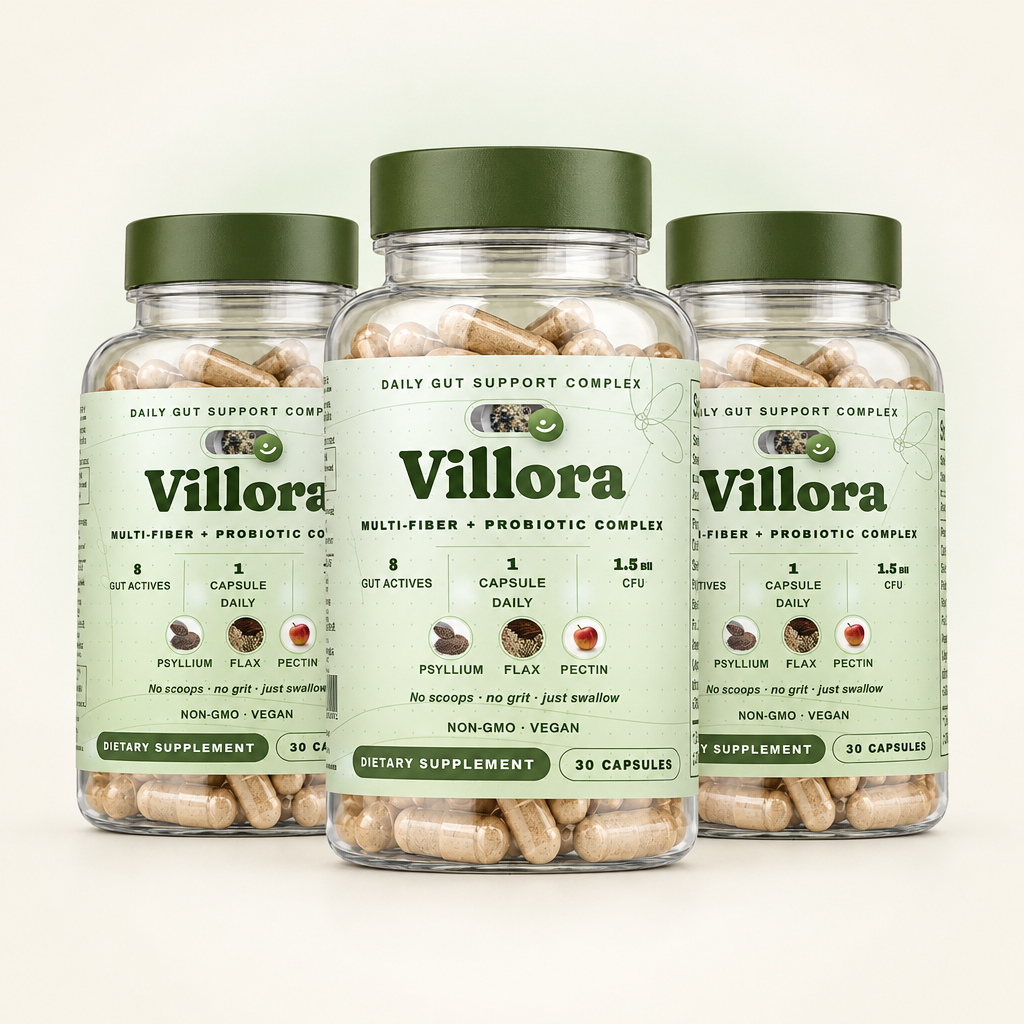
Villora is a once-daily capsule combining six soluble fibers, one botanical and one probiotic strain — 695 mg in total, 1.5 billion CFU of Lactobacillus acidophilus, and nothing else. The idea is sound: fiber supports regularity and feeds gut bacteria, and a single capsule removes the scooping and mixing that makes most fiber routines collapse after a few weeks. The honest questions are two. First, the manufacturer does not disclose how much of each ingredient sits inside that 695 mg blend. Second, at $1.63 to $2.30 a day it is not the cheapest way to get fiber — psyllium alone costs a fraction of that. Whether it suits you depends on which of those you weight more heavily.
Most fiber supplements fail for a boring reason: people stop taking them. Powders need a glass, a spoon and a willingness to drink something gritty before breakfast. Villora's bet is that a capsule you swallow with water is the version you will actually keep taking for six months. That is a real problem worth solving. This page looks at what is inside the capsule, what it costs per day, and where the formulation leaves questions open.
Check current Villora pricing
Three kit sizes: 2, 4 and 6 bottles. The 6-bottle kit works out at $1.63 a day.
See the 2-bottle kit →Affiliate link · 60-day money-back guarantee per the seller
What's inside
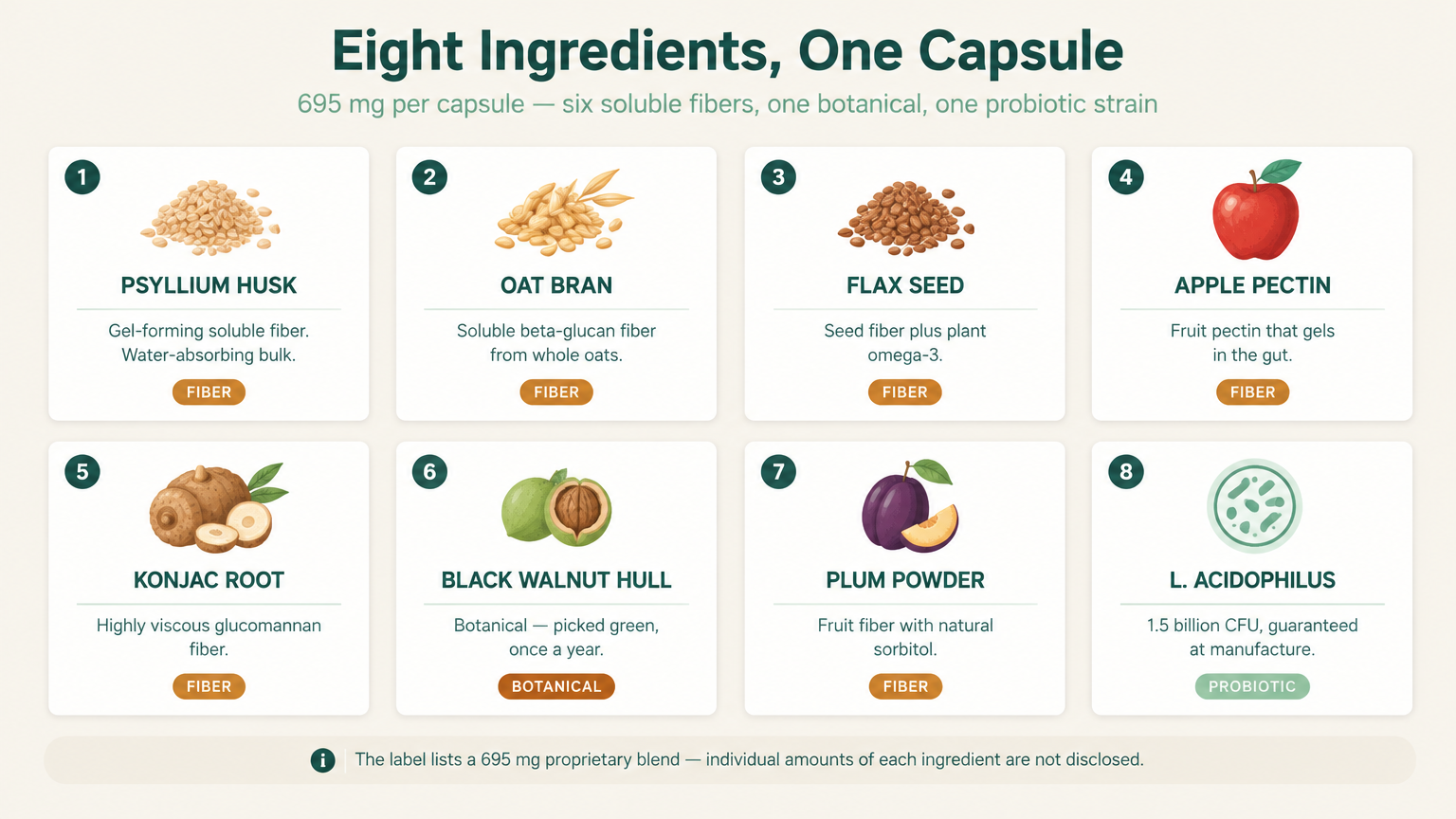
The label is unusually open about the ingredient list and unusually quiet about the amounts. Here is every ingredient, named, with what it actually is.
| Ingredient | Type | What it is |
|---|---|---|
| Psyllium husk | Soluble fiber | Gel-forming; absorbs water and adds bulk |
| Oat bran | Soluble fiber | Beta-glucan fiber from whole oats |
| Flax seed | Seed fiber | Fiber plus plant omega-3 |
| Apple pectin | Fruit fiber | Pectin that gels in the gut |
| Konjac root | Soluble fiber | Glucomannan, a highly viscous fiber |
| Plum powder | Fruit fiber | Fiber with naturally occurring sorbitol |
| Black walnut hull | Botanical | Traditional botanical, picked green |
| Lactobacillus acidophilus | Probiotic | 1.5 billion CFU‡, guaranteed at manufacture |
How the capsule works
The mechanism is straightforward and does not require belief. Soluble fibers absorb water and form a gel in the digestive tract, which adds bulk and softens stool. That is what psyllium, oat bran, pectin, konjac and plum all do, at different rates and with different textures. The probiotic adds a named bacterial strain, and the black walnut hull is a traditional botanical rather than a fiber.
What each kit costs per day
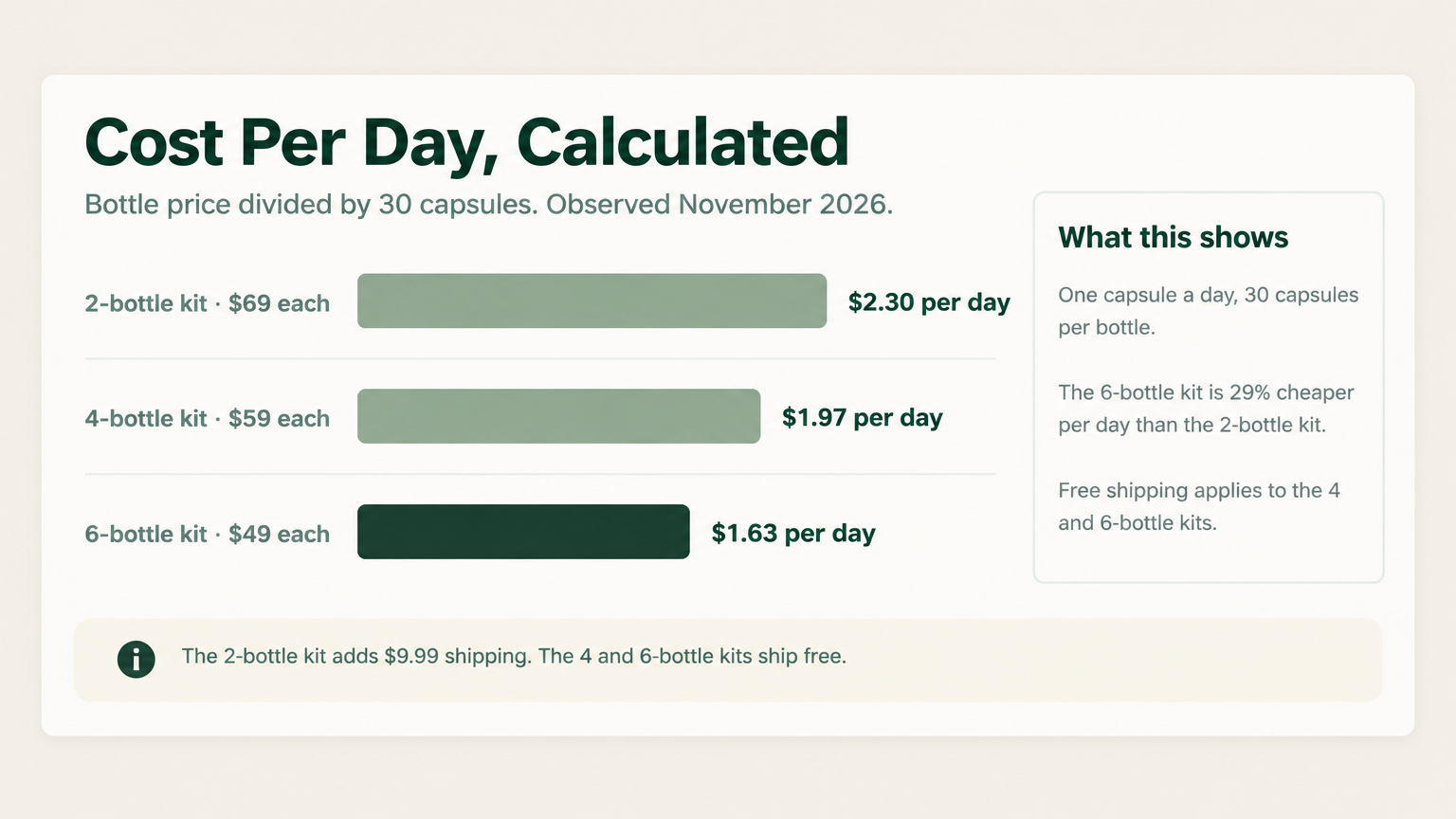
Price divided by 30 capsules, including shipping where it applies.
| Kit | Per bottle | Total | Shipping | Cost per day |
|---|---|---|---|---|
| 2 bottles (60 days) | $69 | $138 | +$9.99 | $2.30 |
| 4 bottles (120 days) | $59 | $236 | Free | $1.97 |
| 6 bottles (180 days) | $49 | $294 | Free | $1.63 |
The 4-bottle kit is the middle ground
$236 total, free shipping, $1.97 a day. Four months is long enough to judge whether a daily routine holds.
See the 4-bottle kit →Affiliate link · free shipping on 4 and 6 bottles
What the label doesn't disclose
This is the section most supplement reviews skip, and it is the one that matters when you are deciding where to spend $294.
| What the label states | What it does not state |
|---|---|
| "8 gut actives" | The amount of each of the eight ingredients |
| "695 mg" total blend | How that 695 mg is divided |
| "1.5 Bil CFU" | Whether that figure holds at expiry or only at manufacture |
| "GMP-certified facility" | Which facility, or any certificate number |
| "60-day guarantee" | That return shipping is paid by the buyer |
Who it suits
Every supplement is a set of trade-offs. The right choice depends on which side of these criteria you fall on.
Reasonable reasons to buy
- You want fiber but keep abandoning powders after a week or two
- You prefer one capsule to three separate daily routines
- You are willing to pay for convenience over bulk volume
- You accept it as a complement to your diet, not a substitute for it
Reasons to look elsewhere
- Fiber dose per dollar is your main purchasing criterion
- You want to know exact milligram amounts of each ingredient
- You need a high gram dose of fiber daily (e.g. 10g+)
- You have a walnut or tree nut allergy
- You are pregnant, nursing, or under 18 years of age
How to take it
If you decide to try the product, the manufacturer's directions and practical considerations are straightforward:
-
1
One capsule with breakfast
The manufacturer's instruction is a single capsule daily with a full glass of water. Water matters: these are gel-forming fibers.
-
2
Start with water, not with more capsules
If you feel bloated in the first week, the usual cause is insufficient water rather than the fiber itself.
-
3
Give it three to four weeks
Fiber routines are cumulative. Judging a supplement like this on four days tells you nothing.
-
4
Keep it visible
The capsule format exists so the routine survives busy mornings. Put the bottle where you already reach for something daily.
-
5
Mention it to your doctor if you take medication
Soluble fiber can affect how some oral medications are absorbed. The manufacturer advises taking fiber at least two hours apart from other oral medications.
The complete routine is the 6-bottle kit
$294 total, free shipping, $1.63 a day, and the lowest per-bottle price in the lineup.
See the 6-bottle kit →Affiliate link · 60-day money-back guarantee
Frequently asked questions
Common questions about formulation, pricing, guarantees, and practical use.
What is Villora?
Does Villora work?
How much fiber is in one capsule?
Is Villora safe?
Can I take it with Ozempic or another GLP-1?
How much does it cost?
Is there a subscription?
What if it doesn't work for me?
Where is it made?
Where this leaves you
Villora is a well-constructed idea with one unresolved question. The idea: a capsule solves the reason fiber routines fail, and six fibers plus a named probiotic strain is a more complete approach than psyllium alone. The question: a proprietary blend of 695 mg means you cannot know how much of each ingredient you are getting, and at $1.63 to $2.30 a day you are paying for convenience rather than for volume.
If you have tried fiber powders and stopped — twice — then a capsule you swallow in ten seconds is worth the premium, and the 60-day guarantee covers the experiment. If you have never tried fiber and simply want more of it, a bag of psyllium costs a tenth as much and does the same mechanical job. Neither choice is wrong. They are answers to different questions.